How often should a resin driveway be cleaned?
6 min read Resin Revive
Resin bound surfaces are permeable by design, which is exactly why they collect organic matter. The interval depends on where your drive sits, not the calendar.
There is no universal answer, and anyone giving you one has not looked at your drive. A resin surface under an overhanging sycamore on a north-facing frontage is a different proposition to one in open sun. What is useful is knowing what actually drives the interval.
Why resin collects dirt in the first place
Resin bound is permeable on purpose. Water drains through the surface rather than running off it, which is what keeps it compliant with drainage rules and free of puddles. The same open structure that lets water through also lets everything else in: windblown soil, leaf fragments, pollen, moss spores.
That material settles into the voids between the stones. Left alone it composts down into a thin layer of organic matter, and once that layer exists, moss and algae have somewhere to root. This is why a resin drive can look fine for four years and then decline quickly — the surface has finally accumulated enough for growth to take hold.
What actually sets the interval
- Aspect. North-facing and shaded areas stay damp and go green first. A drive that dries out after rain will go far longer between cleans.
- Overhanging trees. The single biggest factor. Leaf fall, sap and berries all feed the surface.
- Traffic. Tyres grind material into the voids and bring in road dirt.
- Whether it has been sealed. A sealed surface sheds more and traps less, so it stays cleaner for longer.
As a working rule, a light annual maintenance clean keeps most drives ahead of the problem, and a shaded drive under trees may want it more often. What you want to avoid is the reactive pattern — leaving it until it looks bad, which is the point at which the growth is established and the job is bigger.
The signs it is overdue
Water pooling on the surface is the important one. Resin should take rain straight through; if it is sitting on top, the voids are blocked and the drive has stopped doing the job it was installed to do. Green film, a darkened look that does not come off in rain, and a slightly slippery feel underfoot in winter all point the same way.
Why the method matters more than the frequency
This is where resin differs from block paving, and where most of the damage we are called out to fix comes from. Resin is stone held in a resin matrix. Too much pressure, or a narrow lance held close, strips resin from around the stones and starts them working loose. Once stones are coming out, cleaning is no longer the fix.
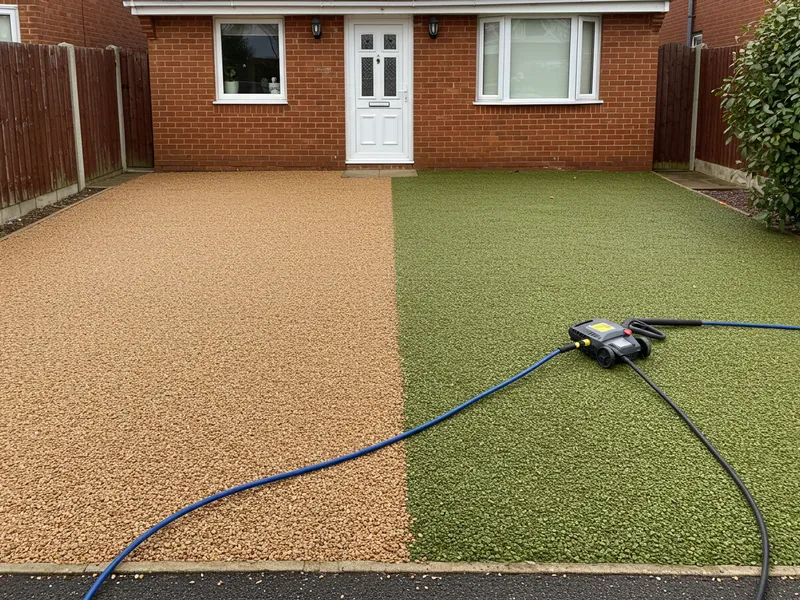
A proper deep clean uses controlled pressure through a rotary head that keeps a consistent distance across the whole surface, with a treatment that kills the growth rather than simply blasting the top off it. Killed growth does not come straight back; growth that was merely removed does.
When cleaning is no longer enough
Cleaning restores the surface. It does not restore the resin. If the drive has lost its binder to UV and traffic — stones lifting, a rough or crumbly feel, patches going bare — then it needs recoating rather than washing, and cleaning it repeatedly will only accelerate the loss.
The honest sequence is: clean while the surface is sound, recoat when it is not, and get someone to tell you which of the two you are actually looking at before spending money on either.
Common questions
- Can I jet wash a resin driveway myself?
- A domestic washer held close enough to shift moss is also close enough to blast stone out of the matrix. Resin needs controlled pressure at a consistent distance, which is what a rotary surface cleaner does and a hand lance does not.
- How do I know when it needs doing?
- Water sitting on the surface instead of draining through is the clearest sign. A resin drive that puddles has clogged joints and is overdue.
- Does cleaning damage the resin?
- Done correctly, no. Done with too much pressure or a narrow lance, yes — it strips resin from around the stones and starts the loose-stone problem.